Tuesday, October 9, 2018

Caroline Hollingsworth Named “Rising Star in Law 2018” by the Birmingham Business Journal

HGD attorney Caroline Hollingsworth was named “Rising Star in Law 2018” by the Birmingham Business Journal. The fourth annual Birmingham’s Rising Star Lawyers Awards honor up-and-coming attorneys under the age of 40. Honorees were selected based on their contributions to the firm, tangible results in their practice areas and involvement in the community, among other factors.

Caroline attended the University of Alabama for her undergraduate studies and acquired a degree in political science and history. She later obtained a scholarship to William Bowen School of Law in Little Rock, Arkansas. She has been practicing in the area of Mass Torts at HGD for seven years. During her tenure at the firm, Caroline has been the head of the firm’s Vaginal Mesh Litigation helping close to 2,000 clients-helped facilitate settlements. She also worked on the Syngenta Corn Litigation-which is now in settlement.

Caroline and her husband, Jonathan, have two daughters and two dogs. They attend Hunter Street Baptist Church and serve on their neighborhood’s planning committee. In her spare time, Caroline also volunteers with the Junior League of Birmingham and enjoys running and watching college football.


The post Caroline Hollingsworth Named “Rising Star in Law 2018” by the Birmingham Business Journal appeared first on .

Monday, October 8, 2018

Congratulations to the Winners in HGD’s 2018 Closing Argument Competition “In Summation”!

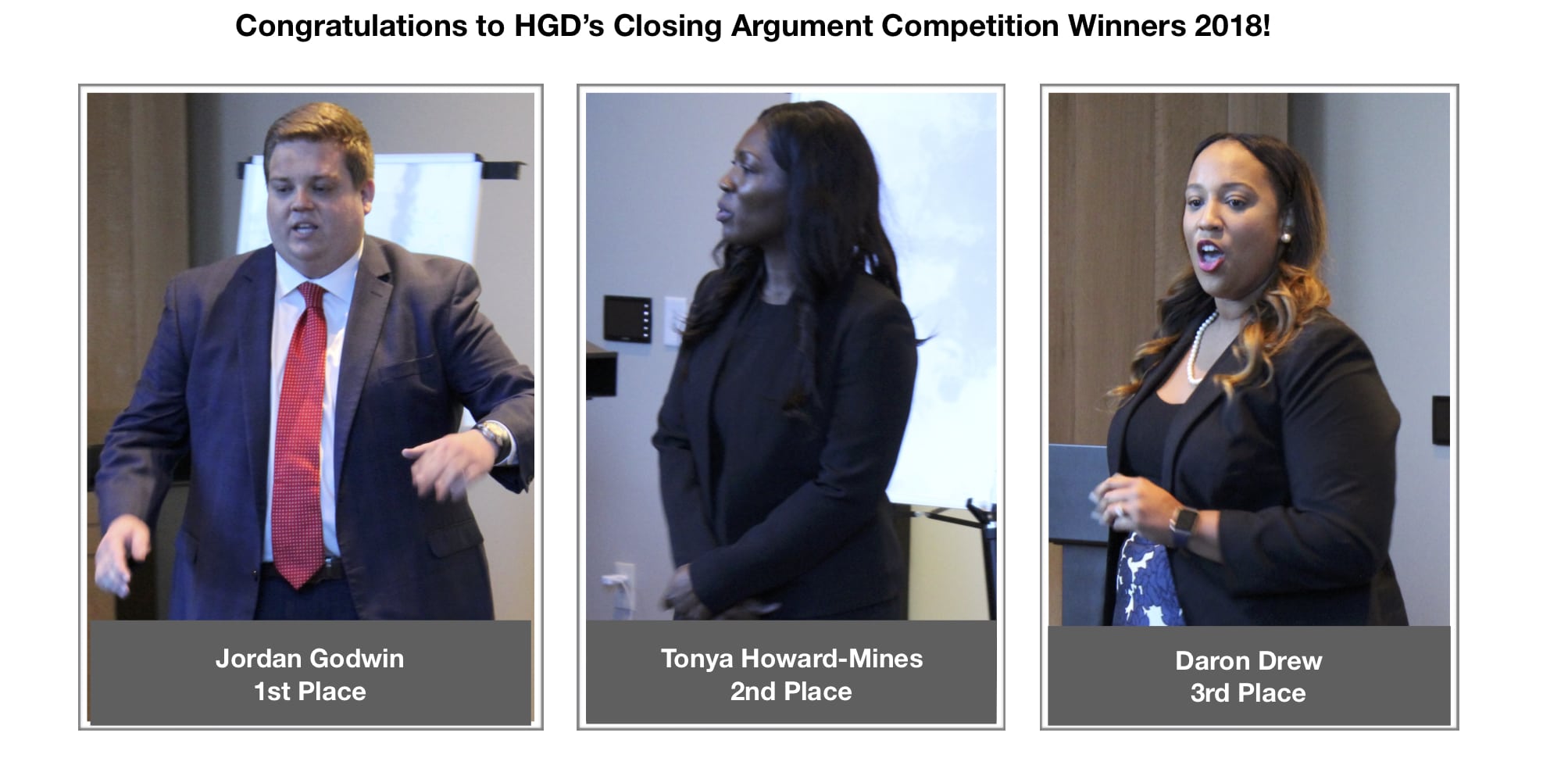
Congratulations to the winners in HGD’s 4th Annual “In Summation” Closing Argument Competition: Cumberland’s Jordan Godwin wins 1st Place and $1000; BSL’s Tonya Howard-Mines wins 2nd Place and $750; and Daron Drew from BSL wins 3rd Place and $500. HGD holds this competition for local law school students to help promote advocacy and reward those law students for advancing their advocacy skills.

Held in the  Stephen D. Heninger Moot Court Room, the original field of competitors was narrowed down to a top six who paired off in the final rounds last night. The jury was comprised of HGD attorneys and staff, and HGD attorneys Drew Haskins and Chris Hood presided over the competition as the judges.

An official presentation of the winning prizes is forthcoming. HGD congratulates all the law students who competed the last two weeks.

The post Congratulations to the Winners in HGD’s 2018 Closing Argument Competition “In Summation”! appeared first on .

Wednesday, October 3, 2018

Congratulations to the 6 Finalists in HGD’s 2018 Closing Argument Competition!

Congratulations to the top 6 finalists in HGD’s 4th Annual Closing Argument Competition 2018, “In Summation.” The six finalists who will be competing for the top three spots this week are Christine Bussey, Taylor Dant, Daron Drew, Jordan Godwin, Dylan Scilabro, and Tonya Vines.

Heninger Garrison Davis takes great pride in this event and the learning opportunity it provides for students attending Cumberland School of Law and Birmingham School of Law. Our goal is to encourage advocacy and reward those law students for advancing their advocacy skills.

Each participant was given a trial problem and asked to present a closing argument before a mock jury that includes judges, lawyers and laypersons. The final round is Thursday, October 4 in the Stephen D. Heninger Moot Court Room in our downtown Birmingham office.

The prizes for the top three are: 

1st Place will receive $1,000 & an engraved plaque

2nd Place will receive a check for $750 & an engraved plaque

3rd Place will receive a check for $500 & an engraved plaque

Good luck to all our finalists!


The post Congratulations to the 6 Finalists in HGD’s 2018 Closing Argument Competition! appeared first on .

Tuesday, October 2, 2018

Three Positive Impacts of Mass Tort Claims

by HGD Staff

Talk to most average Americans about “class action” lawsuits, and you will probably hear all sorts of myths and rumors about how these lawsuits are ‘frivolous’ or driving up insurance rates. Sadly, these views are usually misinformed and focus on isolated anecdotal stories rather than facts. In truth, mass tort claims often have a huge impact on changing legislation and improving the quality of life for Americans everywhere. To illustrate just how important these types of cases can be, consider the following five changes that have happened because of mass tort cases.

Toxic Waste is Bad, 1984

 From the 1950s through the 1970s, the Occidental Chemical Company routinely dumped toxic chemicals into a landfill in Niagara, New York. The “Love Canal” site became so hazardous that people started showing signs of chemical exposure, including increases in cancer and mortality rates. A massive class action lawsuit ultimately brought the matter to national attention.

According to court documents from the case, Skey v. Occidental Chemical, 102 A.D. 2d 130 (4th Dept. 1984), the company admitted to dumping about 80,000 tons of waste, including as many as 25 chemicals. In fact, the problem was so pervasive that the drainage site became known as “Bloody Run Creek.” Today, the U.S. Environmental Protection Agency (EPA) has entered into Administrative Consent Orders with the company in order to mitigate and prevent such problems.

Big Tobacco Changes, 1998

 It is certainly easy to claim that smoking is a personal choice for adults and that government should not prohibit or interfere with that choice. But what about directly marketing to small children? How about putting addictive chemicals in a product, solely for the purpose of eliminating choice? Well, these are the issues that came up during extended tobacco battles in the 1990s, and while tobacco is still legal, you have probably noticed some changes without even realizing it.

In a sweeping class action case against tobacco companies, the tobacco industry ultimately settled for $206 Billion, being paid out over a period of 30 years. Unlike many class action cases, this one was not brought by private attorneys. Rather, the attorneys general from 46 U.S. states combined efforts to bring the case, alleging that the tobacco industry should have to pay back Medicaid (state-funded public health insurance) for the cost of treating tobacco-related illnesses. The major changes since then have included:

  • Big Tobacco cannot target children
  • Strict rules about how and where they can market and advertise
  • Stricter warnings and labeling

The Enron Scandal

 When people think of mass torts and class action cases, they usually think of cases in which people have been physically injured. Enron and its progeny just go to prove that injuries can just as easily be financial. It all started in 1985, when the company was a fledgling pipeline company arising out of a merger between two companies – Houston Natural Gas and InterNorth. Enron grew rapidly – almost too rapidly. Shortly after 9/11, Enron collapsed in 2001. The company defaulted on thousands of investments, after allegedly misrepresenting the value of stock, lying about their financials, and various other forms of internal corruption. Ultimately, the company settled with investors for $7.2 Billion.

In the wake of Enron, two major pieces of legislation were enacted. First, the Sarbanes-Oxley Act was passed in order to prevent investment fraud and hold large companies accountable to accurate reporting of profits. Next, the Frank-Dodd Act was enacted almost a decade later in 2010, after the recession. While this was in large part a response to the recession, you can find remnants of the Enron scandal throughout the legislation, which aims to protect consumers from corrupt and fraudulent banking industry practices.

Mass Torts and Class Action Claims

 If you or a loved one has suffered a serious loss or injury due to a large corporation’s illegal or reckless conduct, you have specific rights. Many times, existing agreements and funds are in place to compensate victims, provided you meet specific guidelines. These large tort claims are often extremely complex and require knowledge of multi-state legislation and regulatory schemes. Common types of mass torts include:

  • Defective medical devices
  • Pharmaceutical (e.g. “bad drugs”)
  • Defective auto parts
  • Defective vehicle designs
  • Improper engineering and structural designs

Whatever your injury, if your injury was caused by someone else’s carelessness or negligence, you have a right to be compensated. Call Heninger Garrison Davis, LLC to talk to an experienced class action lawyer about your case. We never charge for the consultation, and we only collect a fee if we are able to help you recover compensation.


The post Three Positive Impacts of Mass Tort Claims appeared first on .

Monday, October 1, 2018

Tim Davis selected to Officer of the Business Torts Section of the American Association for Justice

HGD managing partner, Tim Davis, was recently selected to serve as Newsletter Editor of the Business Torts Section of the American Association for Justice. The purpose of this Section is to promote the objectives of AAJ within the field of commercial law and litigation and to that end to research and study and thereafter educate the membership with respect to commercial law and litigation; to foster programs of continuing legal education in regard to the role of the lawyer and the law in commercial litigation; and to promote information exchange and networking among members practicing commercial litigation.

Tim has been a courtroom lawyer for his entire legal career. Having begun his career with one of the leading litigation firms in the Southeast, Tim stepped immediately from the classroom to the courtroom.  He was soon representing individuals in tort actions against major corporations and, by 31 years of age, had been lead counsel in Robins vs. National Security Insurance Companyand Williams vs. Arrow International, Inc., cases resulting in seven figure verdicts for his clients. 

He was soon thereafter appointed by the US District Court to the Plaintiff’s Steering Committee representing hemophilia patients who had received HIV-contaminated blood products.  The case resulted in a $640,000,000 settlement with several pharmaceutical companies.

Tim’s legal practice has broadened dramatically from his initial focus on individual personal injury cases.  Along the way, his practice has included representing entire communities harmed by toxic waste.  Today, a substantial portion of his practice is in the area of business litigation and in protecting the rights of intellectual property owners.

Tim is a 1981 graduate of Florida State University with a degree in Business Administration. He is a 1984 graduate of Cumberland School of Law.  He currently serves as the firm’s managing partner. Tim has authored numerous articles and has been a frequent speaker at continuing legal education seminars.

American Association for Justice Business Torts Section


The post Tim Davis selected to Officer of the Business Torts Section of the American Association for Justice appeared first on .

Steve Heninger presents oral arguments to Alabama Supreme Court in Live Audience forum at Samford University

Steve Heninger

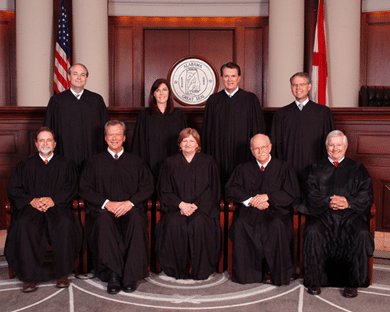
The Supreme Court of Alabama, the Birmingham Bar Foundation and Samford University’s Cumberland School of Law invited guests to observe the Supreme Court of Alabama in a unique day of oral appellate arguments on Wednesday, September 26, 2018. Among distinguished members of the state’s legal community, college and high school students from across the state also attended the session.

The Supreme Court listened to oral arguments on both sides regarding a medical malpractice case.  HGD founding partner, Steve Heninger, presented the oral argument for the plaintiff.  The Supreme Court of Alabama is composed of a chief justice and eight associate justices. As the highest state court, the Supreme Court has both judicial and administrative responsibilities.

The Supreme Court has authority to review decisions rendered by the other courts of the state. It also has authority to determine certain legal matters over which no other court has jurisdiction and to issue such orders necessary to carry out its general superintendence over the courts in Alabama. The Alabama Supreme Court has exclusive jurisdiction over all appeals where the amount in controversy exceeds $50,000 and appeals from the Alabama Public Service Commission.

Chief Justice Lyn Stuart, Associate Justices Michael F. Bolin, Tom Parker, Greg Shaw, James Allen Main, Alisa Kelli Wise, Tommy Bryan, William B. Sellers, and Brady E. Mendheim, Jr.

The chief justice is the administrative head of the state’s judicial system. The Supreme Court may make rules governing administration, practice, and procedure in all courts. Under this authority, rules of practice and procedure and judicial administration have been adopted to eliminate many of the technicalities which cause delay in the trial courts and needless reversals in the appellate courts.

The post Steve Heninger presents oral arguments to Alabama Supreme Court in Live Audience forum at Samford University appeared first on .

HGD Attorneys attend Women En Mass 2018 in Aspen

Now in it’s 6th year, Women En Mass was held in September and brings together the best and brightest female mass tort attorneys from across the country todiscuss issues that affect women—from the boardroom to the courtroom.

Founded and hosted by Aimee Wagstaff of Andrus Wagstaff, Women En Mass provides a chance to bond with fellow attorneys, strengthen existing relationships and create new connections in one of the most beautiful places in the Western United States: Aspen, Colorado. The world may have changed a great deal for women in America over the last 100 years, but there’s still work to be done. And WEM is the perfect opportunity to work toward solutions that can make a positive impact on the lives of women everywhere.

The attorneys attending from Heninger Garrison Davis are:  Jeanie Sleadd, Amanda Williamson, and Caroline Hollingsworth – pictured to the far right in this photo. 


The post HGD Attorneys attend Women En Mass 2018 in Aspen appeared first on .